Reclaim Your Monday: From Forensic Reporting to Forward-Looking Schedule Control
Most project controls teams spend Monday morning documenting what already went wrong. Here's how automating the DCMA-14 health check turns those lost hours into the forward-looking analysis that actually steers a project.
Every Monday, the same ritual repeats in project controls offices across the industry. Open Primavera P6. Export to Excel. Build the pivot tables. Hunt the logic gaps, the open ends, the hard constraints, the negative float. Reconcile the numbers. Format the report.
Three hours later, you have a beautiful document describing a schedule that has already moved on.
This is the quiet trap of modern project controls: we have turned a forward-looking discipline into forensic reporting. Teams pour their best hours into explaining what already happened instead of forecasting what is about to. As the saying goes — you are not managing the project; you are documenting its deviations.
The bottleneck isn't the analysis — it's trusting the schedule
Before you can forecast the ripple effect of today's field decisions on the completion date and final budget, you need one thing: a schedule whose logic you can actually trust.
That's what the DCMA 14-point assessment exists to verify. It's the industry benchmark for schedule quality, checking the integrity of the network logic and the realism of the plan:
- Logic — missing predecessors or successors (open ends)
- Leads & lags — negative lags and excessive positive lags
- Relationship types — over-reliance on Finish-to-Start vs. SS/FF/SF
- Hard constraints — date constraints that override the network
- High float, negative float, high duration, invalid dates
- Resources, missed tasks, critical path test, CPLI and BEI
The problem is not the check — it's the cost of running it. Done by hand on a real program, the DCMA-14 assessment is slow, inconsistent between analysts, and the first thing that gets skipped when a deadline closes in. So teams either run it once a month, or not at all — and default back to forensic mode.
Collapse the check from hours to minutes, and the math flips
The fix isn't to work faster. It's to make the schedule health check disappear as a manual task altogether — so the time it used to consume goes back to forward-looking work.
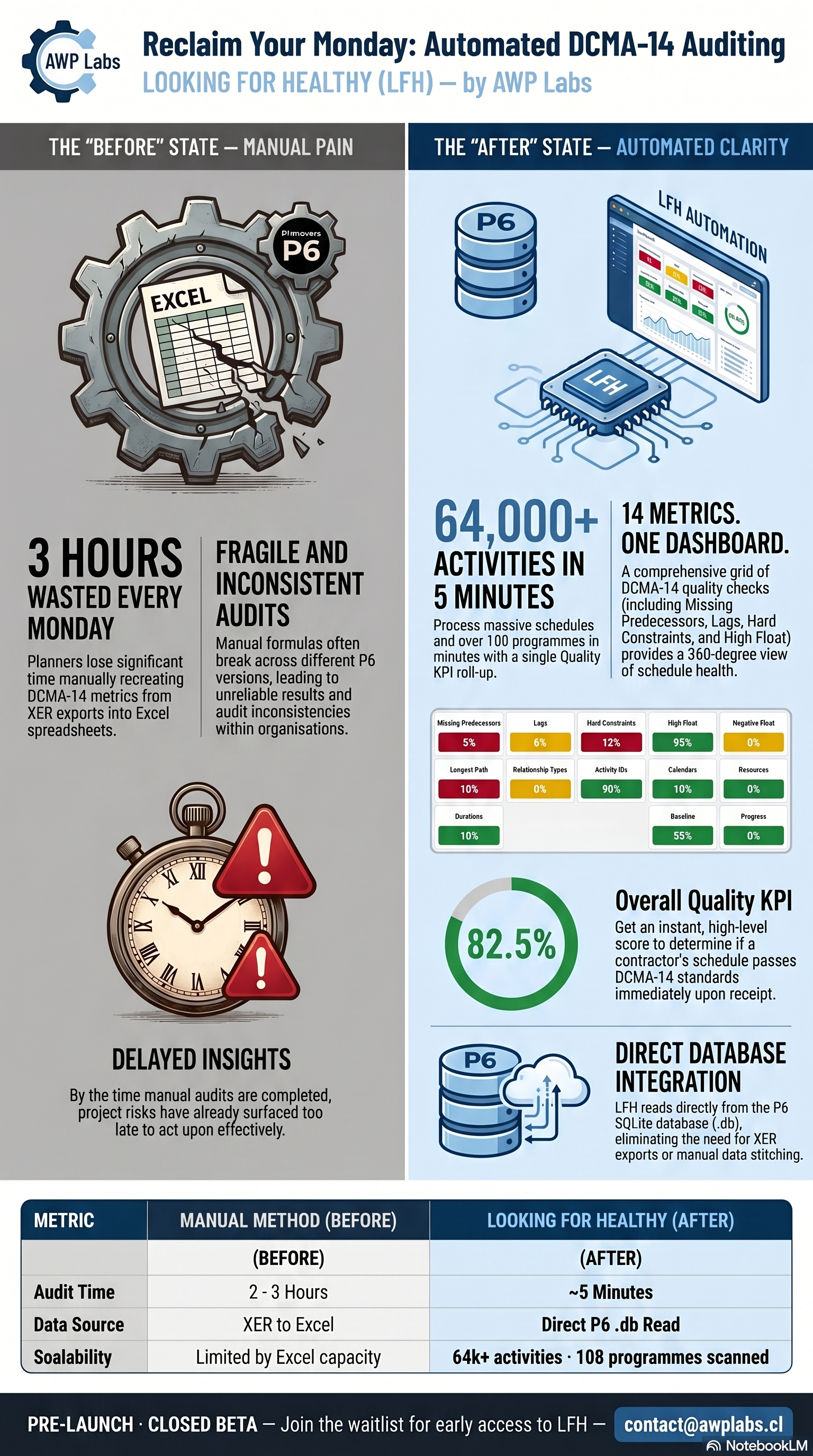
That is exactly what we built LFH — Looking for Healthy to do. Point it at a Primavera P6 program and it runs the full DCMA-14 assessment automatically:
- Reads the P6 database directly — no XER export, no Excel stitching, no broken links between revisions.
- 14 metrics in one dashboard — every DCMA-14 check, plus an overall schedule-quality KPI that tells leadership the health of the program at a glance.
- Scales to real programs — 64,000+ activities across 108 schedules, assessed in roughly five minutes.
From documenting deviations to steering the project
When the health check takes five minutes instead of three hours, something changes beyond convenience. The audit stops being a monthly event and becomes a continuous baseline you can trust. And the hours you used to lose to forensic reporting are suddenly free for the work that creates value: forecasting ripple effects, running scenarios, and steering the project before the deviation happens — not after.
That's the difference between a plan that looks good on paper and one that delivers certainty of execution.
Reclaim your Monday. Spend it steering the project — not documenting its deviations.
LFH is in closed beta. We're onboarding a limited group of early-access users before the public launch at awplabs.cl. If you run DCMA-14 audits on Primavera P6 and want your Monday mornings back, join the waitlist.